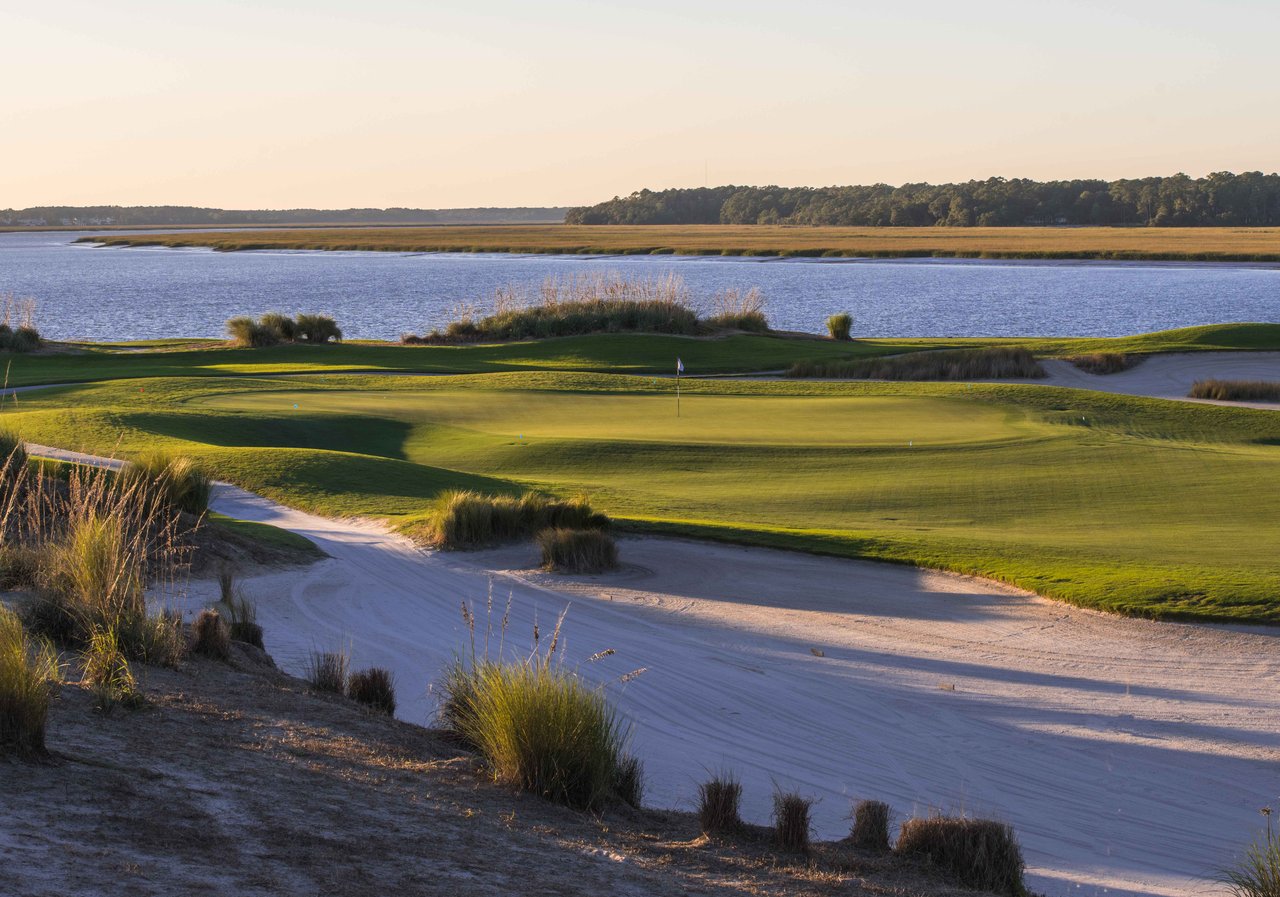
Pete Dye once said the course he built at Colleton River was the best he'd ever done. He said it about a links-style layout carved between live oaks and Port Royal Sound, a course with greens so small and pot bunkers so deep that Golf Magazine still ranks it among the country's top 100. Members who live along its fairways year-round know the compliment holds up. What fewer of them stop to think about is what happens on that same course every late winter, when a wave of college golf teams arrives, plays 54 holes of stroke play, and leaves behind a check that funds food, housing, and medical care across Bluffton.
The Colleton River Collegiate wrapped its 14th edition this year, running February 28 through March 2, with 15 programs on the Dye Course including host Michigan State, Cincinnati, Indiana, Iowa, Iowa State, Kansas State, Kentucky, Memphis, Minnesota, Missouri, Northwestern, Ohio State, Rutgers, East Tennessee State, and UT-Chattanooga. For members watching from the clubhouse porch, it can look like any other week of good weather golf. It isn't. This tournament is one of only three collegiate charity golf events in the entire country, and the mechanism behind it says more about how this community actually operates than any amenity brochure does.
A Member Who Never Stopped Being a Spartan
The tournament exists because of one couple's specific history. Al Thiess played golf for Michigan State from 1964 to 1968, and decades later, as a Colleton River member, he wanted to give something back to both his alma mater and the sport that shaped him. Working directly with MSU's coaching staff, he and his wife Willa built the inaugural event in 2013 around four schools. Al passed away in 2017, but the tournament kept his name attached to it in practice if not on paper, and the club still frames every March around the tradition he started.
That tradition continues: Michigan State remains the host more than a decade later, and the tournament's own materials describe it as honoring "a legacy of generosity through the sport."
What 15 Teams on the Dye Course Actually Means
The field isn't ceremonial. Cincinnati arrived in 2026 ranked No. 39 nationally, and senior Ryan Ford came in with a 69.36 scoring average across his fall season, good enough to push him to 41st in the PGA Tour University rankings released in late February. Northwestern, Kentucky, Ohio State, Kansas State, Iowa State, Rutgers and Chattanooga also brought ranked lineups. These are players competing for standing that follows them onto the PGA Tour's developmental pathway, and they're doing it on a course that has already hosted the South Carolina Amateur, a US Amateur Qualifier, a US Open Qualifier, and the 2015 US Junior Amateur.
The tournament chairman, Tom Eagan, describes the event this way: "This event is about more than golf. It's about making a lasting difference in our community." The quote reflects the tournament's stated community mission, which is also visible in how its proceeds are distributed.
Where the Money Actually Lands
Donations from the tournament flow through the Colleton River Collegiate Fund, held under the Community Foundation of the Lowcountry, a 501(c)(3) that carries a 100 percent four-star rating from Charity Navigator for financial transparency. Once the tournament closes its books, net proceeds transfer to the Colleton River Charitable Fund, a separate entity that has operated inside the club for 25 years with one stated mission: ending the cycle of generational poverty in the greater Bluffton community. That fund currently issues grants to more than 25 local nonprofit organizations working in hunger, housing, health, and education.
The dollar figures track that mission closely. In the Colleton River Collegiate Fund's first three years after its 2022 creation, the tournament raised more than $185,000, all of it directed toward food, shelter, and medical care for Beaufort County families. The 2026 tournament alone added a record $75,000 to that total, presented at a ceremony on the Nicklaus Club lawn on April 14, 2026, described by organizers as the largest single contribution in the event's history. That ceremony brought together representatives from the tournament, the charitable fund, and club leadership, a detail that signals this isn't a check mailed quietly to a foundation. It's a public accounting, held on the property, in front of the members who made it possible.
The public presentation is one visible part of the tournament's charitable work. The tournament has grown from four schools in 2013 to 15 or more today.
The Fairways Have a Screen Credit Too
There's a second layer to the Dye Course that has nothing to do with golf rankings. In the fall of 1999, Robert Redford spent time scouting the Lowcountry for his film "The Legend of Bagger Vance," and the majority of the movie's golf scenes were shot at Colleton River. The production notes at the time cited the course's classic, indigenous character as the reason it beat out more modern layouts. When Redford died last September, several regional news outlets pointed back to that connection, noting the course had been discovered specifically for its old-world feel rather than any flash.
It's a detail longtime members already trade with visiting family, but it's worth stating plainly here: the same undulating greens hosting Cincinnati's PGA Tour University prospects this spring are the ones Will Smith and Matt Damon walked a quarter century earlier. Few private courses can claim both a US Open qualifying pedigree and a DreamWorks film credit.
What Else the Club Actually Underwrites
The collegiate tournament is the largest philanthropic effort at Colleton River, but it isn't the only one, and understanding the others helps explain why the golf event fits so naturally into the club's culture rather than standing apart from it. Members run an annual Play for P.I.N.K. event supporting breast cancer research. The First Tee of the Lowcountry teaches area children life skills through golf, a natural extension of a club built around the game. A volunteer group called the Colleton River Cat's Care Group looks after the community cats living on the property, a small but telling sign of how members organize around things that matter to daily life inside the gates. And a food collection campaign started in April 2020 has since donated more than 5,000 bags of non-perishable groceries to the Bluffton food bank, run by members who sign up for Monday porch pickups across the neighborhood.
None of this is unusual for a private club to publicize. What's unusual is the scale of the golf tournament relative to everything else on that list, and the fact that its charitable structure runs through an outside, independently rated foundation rather than staying entirely in-house.
What to Watch For Next Spring
The tournament's own site already lists dates for its next edition, March 7 and 8, 2027, which will make it the 15th annual playing. If the pattern holds, expect another 15-team field, another round of ranked programs treating the Dye Course as a real proving ground, and another spring ceremony on the Nicklaus Club lawn with a dollar figure attached. This is one of three tournaments of its kind in the country, and the fairways members walk every other week of the year are doing quiet, measurable work for their neighbors the rest of the time.
If you're curious about what else shapes daily life inside Colleton River, or you're weighing a move to the Lowcountry and want a local perspective grounded in more than listing photos, the Ussery Group has spent years working this market from the inside. Reach out anytime for an honest conversation about what makes this community what it is.